Category: AI

AI SENSE - Think before you prompt
8 QUESTIONS TO ASK BEFORE USING AI IN YOUR MARKETING

AI can write the copy.

Build the presentation.

Analyse the data.

Generate the image.

Summarise the research.

Suggest the strategy.

But should it?

We’re big fans of AI at chicken/egg. We use it every day, experiment with it and have built our own GPTs to help us think, create, analyse and get stuff done.

But when a tool makes something quicker and easier, it’s tempting to start with the tool.

Can AI write this?
Can AI create that?
Can we automate this?

Maybe.

But that’s not the first question.

What does the marketing need to do?

AI isn’t your marketing strategy. It’s a tool you might use to help deliver it.

So before you open ChatGPT, Claude, Gemini or whatever shiny new AI tool has landed in your inbox this week, use a more important tool first.

Your brain.

AI SENSE is our 8-question marketing sense check. It’ll help you work out where AI can genuinely help, where human thinking matters more and whether the work coming out the other end is actually any better.

Grab a coffee. Grab the brief. Then think before you prompt.


1 – WHAT’S THE MARKETING PROBLEM?
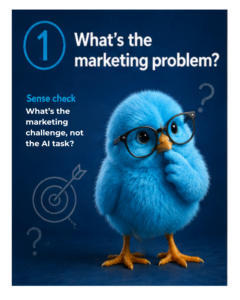
Start with the job, not the tool.

What problem are we trying to solve, or what opportunity are we trying to create?

Are we trying to change a perception? Generate demand? Improve conversion? Retain more customers? Launch something new? Make a better decision?

Ask yourself

  • What are we actually trying to achieve?
  • What needs to change?
  • Why does it matter to the business?
  • How will we know if it worked?
  • Is AI the best way to help us get there?

Watch out for…

Starting with the tool

AI makes it easy to create more content, more ideas and more activity.

That doesn’t automatically create more value.

Sense check

What’s the marketing challenge, not the AI task?

If you can’t explain the challenge without talking about the tool, you’re probably starting in the wrong place.


2 – WHAT DO WE KNOW ABOUT THE CUSTOMER?
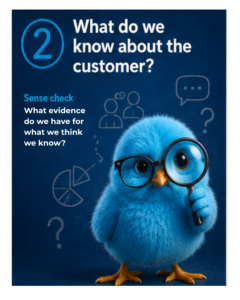
AI knows a lot.

It doesn’t necessarily know your customer.

Good marketing starts with understanding the people we’re trying to create value for. What they need. What matters to them. What’s getting in their way. Why they choose you, or don’t.

AI can help us explore customer research, interrogate data and spot patterns.

But it shouldn’t invent the customer.

Ask yourself

  • Who are we trying to reach or influence?
  • What do we actually know about them?
  • Where has that knowledge come from?
  • Are we working with real insight or assumptions?
  • Are we asking AI to analyse customer insight or create it?

Watch out for…

Synthetic certainty.

Ask AI to describe your target customer and it’ll happily give you their motivations, frustrations, buying habits and possibly their preferred brand of oat milk.

Doesn’t make it true.

Sense check

What evidence do we have for what we think we know?

AI can help you interrogate customer insight. It isn’t a replacement for talking to customers.


3 – WHAT JOB SHOULD AI DO?
AI doesn’t need to do everything. And it probably shouldn’t.

It might help generate ideas, challenge your thinking, analyse information, create a first draft, adapt existing work or take a repetitive job off someone’s plate.

AI might be brilliant for one bit of the job and rubbish for another.

Decide where you actually need it.

Ask yourself

  • What exactly do we want AI to help with?
  • Where in the process should it get involved?
  • What happens before AI?
  • What happens after it?
  • Is AI actually the best tool for this job?

Watch out for…

Handing over the whole job.

Ask AI to “create our marketing strategy” and you’ll probably get 2,000 beautifully structured words.

That doesn’t mean you’ve got a strategy.

Sense check

Could you brief AI’s role as clearly as you’d brief someone on your team?

If the job is vague, don’t be surprised when the answer is too.


4 – WHERE’S THE HUMAN THINKING?
AI can give you an answer in seconds.

Knowing whether it’s a good answer is the clever bit.

Someone still needs to understand the business, customer, competition, brand and commercial reality well enough to question what’s coming back.

AI can contribute to the thinking.

It shouldn’t quietly become the thinking.

Ask yourself

  • Who owns the decision?
  • Does someone with the right experience understand and review the work?
  • Are we questioning the output or simply accepting it?
  • What have we added from our own experience and knowledge?
  • Would we make the same decision if AI hadn’t suggested it?

Watch out for…

Confidence being mistaken for competence.

AI is very good at sounding like it knows what it’s talking about.

Sometimes it does.

Sometimes it’s wearing a tiny imaginary suit and bluffing its way through the meeting.

Sense check

Who’s accountable for the final decision?

Hopefully the answer isn’t ChatGPT.


5 – COULD THIS HAVE COME FROM ANY COMPETITOR?
AI is very good at producing things that look and sound like things that already exist.

That’s useful.

It’s also how everything starts sounding the same.

Your brand needs to bring the things AI doesn’t have by default: your point of view, personality, experience, stories and distinctive way of seeing the world.

Ask yourself

  • Does this sound like us?
  • Does it reflect what our brand stands for?
  • Is there an actual point of view?
  • Have we added examples, experience or ideas that only we could contribute?
  • Could a competitor publish this tomorrow with their logo on it?

Watch out for…

Perfectly acceptable beige marketing.

Polished. Professional. Correct.

And completely forgettable.

Sense check

If we removed the logo, would anyone know it was ours?

If a competitor could copy it tomorrow, AI probably hasn’t made your marketing better.


6 – CAN WE TRUST IT?
AI can be wrong.

Very convincingly wrong.

So when it’s helping with research, analysis, claims, copy, recommendations or decisions, check the bits that matter.

Don’t confuse a confident answer with a correct one.

Ask yourself

  • Have we checked the facts?
  • Are the figures, quotes and sources real?
  • Is the information current?
  • Have we challenged the assumptions?
  • Could bias affect the answer or the work we’re creating?

Watch out for…

“ChatGPT said…”

AI isn’t a source.

Sense check

Could we show where this information came from?

If it matters enough to publish or make a decision on, it matters enough to check.


7 – WOULD WE BE HAPPY EXPLAINING THIS?
Would you happily tell the client what you uploaded?

Would you tell a customer how their information was used?

Could you explain where the image, claim or idea came from?

And would you happily put your name against the finished work?

If any of those questions make you shuffle awkwardly in your chair, it’s probably worth looking again.

Ask yourself

  • Are we putting confidential business or client information into AI?
  • Are we using personal or customer data?
  • Do we have the right to use the material we’re giving it?
  • Have we thought about ownership, copyright and usage?
  • Could the output mislead someone?
  • Would we be comfortable explaining exactly how AI was used?

Watch out for…

Copy. Paste. Regret.

Saving 10 minutes isn’t worth damaging client confidence or customer trust.

Sense check

Would you be comfortable putting your name to it?

If not, find out why before you carry on.


8 – DID AI MAKE THE MARKETING BETTER?
AI can make things quicker.

Great.

It can make things cheaper.

Also great.

Maybe it saved you 3 hours. Maybe it helped you spot something you’d missed. Maybe it gave you 20 ideas and one of them was brilliant. Maybe the work performed better.

But AI always comes with a trade-off.

What did we gain?

And what might we have lost?

Speed at the expense of originality?

More personalisation but less humanity?

50 ideas and another hour deciding which one is any good?

The goal isn’t to use more AI.

It’s to make better marketing.

Ask yourself

  • What got better because AI was involved?
  • Did it save meaningful time or money?
  • Did it improve the quality of the work?
  • Did it help us make a better decision?
  • Did it create more value for the customer?
  • Did it help Brand, Demand or Expand?
  • What might we have lost along the way?

Watch out for…

Mistaking more for better.

50 posts instead of 10.

20 concepts instead of 3.

A week’s work completed in an afternoon.

Brilliant.

But did any of it work?

Sense check

What got better because AI was involved?

If the only answer is “we made more stuff”, keep digging.


THE BEST PROMPT …

…starts long before you open ChatGPT.

AI will keep changing.

New models.

New tools.

New ways of working.

But the fundamentals of good marketing haven’t.

It still starts with understanding people.

Solving real problems.

Making good decisions.

AI can help you do all of those things.

Just don’t hand over the bit that makes you a marketer.

Your judgement.
 

From chaos to AI clarity
How our CREATE framework helps marketers build their own AI assistant*

AI hasn’t just joined marketing.
It’s settled in, learnt the lingo and started showing up to meetings uninvited.

According to HubSpot’s 2025 State of Marketing Report, 92% of marketers say AI has already impacted their role. That’s not a fad – that’s a full-blown shift in how marketing teams think and work.

But here’s the thing: more than half of those marketers admit they still feel overwhelmed by how to use AI effectively.

And that’s not failure – that’s honesty. It shows marketers know AI shouldn’t replace creativity; it should help it hatch faster.


We’re all using AI … but are we using it well?

Most marketing teams are deep in AI experimentation.
Prompts, plugins, “let’s see what it comes up with.”

But here’s the problem: While AI can churn out copy at lightning speed, it still doesn’t sound like you.

So yes, you get faster first drafts – but you also get more editing.
More output, sure. Not always more impact.

At chicken/egg, we see it all the time. Teams know AI could save time, but they don’t trust it to stay on brand.
And fair enough – why would you trust a tool that doesn’t know your tone, your rules or your audience?

That’s why we created CREATE – our framework for turning generic AI into your brand’s most reliable team-mate.


The problem isn’t capability – it’s control

Most AI tools are generalists. Brilliant at everything. Specialists in nothing.

They don’t know your voice, your style or where to draw the line between ‘bold’ and ‘off-brand’.

The result? Inconsistent copy, wasted hours and that all-too-familiar moment when you mutter: “Fine, I’ll just rewrite it myself.”

The CREATE framework flips that.
It helps you teach AI how you work – so instead of a tool that needs managing, you’ve got one that actually helps manage the work.


Meet CREATE

CREATE stands for Context, Requirements, Embed, Align, Train, Evaluate – six simple steps to go from chaos to clarity.

Context

Start with purpose. What’s the GPT for? Who’s using it? Get that right and everything else clicks.

Requirements

Set your house rules. Tone, structure, banned words, preferred formats – the details that make it sound like you.

Embed

Feed it your gold. Upload the campaigns, blogs and decks you’re proud of. Let it learn from your best work.

Align

Test it on real briefs. If it sounds off, tweak it until it’s on-brand without needing your red pen.

Train

Keep it sharp. Add feedback and new examples so it evolves with your team, not behind it.

Evaluate

Measure what matters. Time saved. Quality gained. Consistency achieved. Then decide what to build next.


What changes when you get it right

When AI actually understands your brand, everything speeds up without dumbing down.

We built a client a custom GPT and within weeks, we’d cut content turnaround time by 60% – and finally had breathing space to think big again.

Their marketing assistant now:

  • Turns briefs into first-draft campaign routes
  • Writes on-brand blogs with metadata and calls to action
  • Produces client-ready decks and proposals
  • Keeps tone and style consistent across every touchpoint

Our creative team still writes – they just start from something good instead of something blank.


Why we built CREATE

We’ve spent decades balancing creativity and clarity.
When AI showed up, we didn’t panic – we got curious.

What if, instead of replacing writers and strategists, AI could help them think faster, brief smarter and stay consistent?

That’s why we built CREATE.
A framework that makes AI adoption practical.
Something real teams can use every day to make better work, faster.

Because the truth is simple:
AI won’t replace creative people.
But creative people who know how to use AI properly?
They’ll absolutely replace the ones who don’t.


Ready to CREATE yours?

If you’re a marketing leader curious about what AI can really do for your team, we’ll show you how to:

  • Build a GPT that understands your brand voice
  • Train it using your own tone, templates and content
  • Measure its real-world impact on quality and time

Let’s make AI your most reliable team-mate – the one that never misses a deadline or needs another coffee.

Get in touch to learn the CREATE framework and build your own GPT assistant.

chicken/egg – hatching smarter creativity.

* You’ll need a ChatGPT Pro account to hatch your own custom GPT. It’s the platform we use – and the one we recommend for all CREATE builds.


POWER HOUR - hatch your own custom GPT
If you’re a marketer seeking to supercharge your content strategy with the power of AI, our new POWER HOUR – hatch your own custom GPT is here.

Over the past couple of years, we’ve been crafting custom GPTs to enhance our internal processes and client work, transforming our approach to content brainstorming, customer persona development, marketing strategies, brand messaging, creative briefs and more.

We’re now bringing that directly to you, and in our power hour, you’ll develop your own marketing custom GPT to help you with:

Content brainstorming and generation – enhance your content creation process with AI-driven insights and suggestions.

Customer persona development – Craft detailed and accurate customer personas to better target your marketing efforts.

Strategy and marketing plans – Develop robust marketing strategies that leverage AI for maximum impact.

Brand strategy and messaging – Ensure your brand’s voice is consistent and compelling across all channels.

Creative brief creation – Generate precise and effective briefs for your studio or agency, ensuring your creative projects are on point from the start.

You’ll learn our unique CREATE framework – a clear, step-by-step approach to building a powerful custom GPT that actually works for your business.

Why book an hour with chicken/egg?

Experience and authority – We’ve integrated GenAI into our daily business, showcased its power at industry events, completed the CIM AI in marketing course and we’re founding members of the Women4AInnovation Futures think tank.

Proven results – Our custom GPTs have helped us achieve remarkable improvements in efficiency, creativity and strategic alignment.

Hands-on guidance – We’ll work directly with you, offering personalised advice and support to ensure your GPT is tailored to your unique needs.

Ready to get cracking?  Here’s how it works …

Initial consultation – We’ll start with a conversation to understand your specific needs and goals.

Custom GPT creation – Based on our discussion, we’ll work with you to develop a bespoke GPT for your business. Please note that you will need a pro subscription to Chat GPT to build your own custom GPT.

Training session – We’ll provide a hands-on training session, teaching you how to effectively use and customise your GPT.

Follow-up support – After the initial session, we’ll be available to answer follow-up questions and provide additional support to ensure you’re getting the most out of your new tool.

How much does it cost?

Just £845 ex VAT.

Terms and conditions apply – see below. 

Are you ready to transform your marketing content with the power of AI?

Book your POWER HOUR today!

email karen@chickenegg.co.uk to discuss.


Terms & Conditions

The Power Hour session costs £845 (excluding VAT).

The session covers up to 6 attendees. For more attendees, please contact us for a quote.

All sessions are conducted online. For face-to-face meetings or training sessions, please contact us for a quote.

Booking and Payment

Invoices are sent prior to the scheduled call and are payable within seven working days.

Payment must be received in full before the scheduled session.

Cancellation and Rescheduling

Cancellations or rescheduling requests must be made at least 48 hours in advance.

If a session is cancelled with less than 48 hours’ notice, 50% of the session fee will be charged.

Rescheduling requests made with less than 48 hours’ notice will incur a rescheduling fee of £50.

Confidentiality

All information shared during the consultancy session is confidential and will not be disclosed to third parties without prior consent.

We respect client confidentiality and ensure that all discussions and materials are handled with utmost privacy and discretion.

Liability

While we strive to provide accurate and useful advice, we do not accept responsibility for any actions taken based on our consultancy sessions.

Our liability is limited to the cost of the consultancy session.

Intellectual Property

Any materials provided by chicken/egg during the session remain the intellectual property of chicken/egg.

Clients may use these materials for internal purposes but must not distribute them externally without permission.

Session Recording

Recording of the session is permitted for internal use only. Clients must inform us in advance if they wish to record the session.

Force Majeure

We are not liable for any delays or failures in performance resulting from events beyond our control, including but not limited to acts of God, natural disasters or technical failures.

Additional Information – Follow-Up Support

Limited follow-up support via email is provided for one week after the session to address any immediate questions or clarifications.

By booking a POWER HOUR, you agree to the above terms and conditions.


AI - a collaborative team member

In a world where AI is often seen as a disruptor, could it become the most collaborative team member you’ve ever had?

AI and the coop – we are embracing the future.

In the fast-evolving landscape of AI, staying ahead means not just keeping pace with technology but embracing its application.

I have just completed the final module of the CIM Specialist Award in AI marketing, a fascinating course designed to equip leaders with a deep understanding of how AI can transform marketing strategies for the better.  The exam is to come, but the course has helped me to see the bigger picture of how AI is (and can be) used and, along with other courses I’ve undertaken via MMC learning, has solidified my knowledge and ongoing experience with AI, especially ChatGPT, my LLM tool of choice at the moment.

AI is not just a tool to me, but a team member … called Kevin.

My journey with AI began with a vision to have a brainstorming/soundboard buddy while working on marketing, content and brand campaigns and to help streamline chicken/egg operations.   The original Kevin – my first custom GPT – was born purely as a chicken/egg team member. I wanted to make AI (well, ChatGPT) less of an enigmatic ‘machine’ and more of a relatable collaborator.

Kevin started as an experiment to bring a personal touch to using AI and make my interactions more human-like and approachable.  For example, I’ll always say please and thank you … along with ‘don’t hallucinate’!  IYKYK

He understands my brand, my voice and my goals. He has helped me with everything from website copy, LinkedIn posts, blogs, and emails to planning how best to respond to pitches, how to position myself at networking events and how to overcome imposter syndrome when I’m feeling unsure about any next step – he’s a loyal team player and even an occasional therapist … all for just $20 a month!

A growing team …

Over the past year, I’ve developed numerous Kevins who act as my internal marketing assistants across the chicken/egg portfolio.  Each is uniquely ‘trained’ in my client’s distinct brand, TOV, vision, values and marketing examples. In developing my Kevin’s, I curate non-sensitive, public data to align with each client’s unique brand essence, ensuring he acts as an informed extension of the team without compromising confidentiality. This approach safeguards sensitive data, leveraging isolated custom AI models that prevent data from being shared beyond our controlled environment. This careful balance between innovation and privacy is central to our AI integration, ensuring Kevin evolves as a secure, private ally in our creative process.  Kevin can then offer real-time insights, content generation and data analysis, all tailored to my client’s specific needs and brand identities, without me needing to start the key prompting all over again in a new chat.

So far, Kevin is just a part of the chicken/egg team. Still, I can see a future where we introduce him directly to a client, and they can take full advantage of having another marketing team member support their internal endeavours.

A future forged together.

My embrace of AI reflects my belief in the power of technology to amplify human potential, not replace it; in fact, it’s far from it at present. By combining the chicken/egg creative acumen with AI’s generative and analytical prowess, I think I’m working smarter and faster, unlocking new possibilities and redefining what’s achievable in our agency offering.  However, Kevin needs the proper prompts, ongoing guidance, refinements and edits – and that requires the know-how and experience that, right now, still needs the human touch.  I’m not ready to be entirely replaced quite yet!

If you’re curious about AI or want to explore how a ‘Kevin’ could benefit your marketing efforts, ping me a message with any questions.

Caveat:  Kevin isn’t perfect, and I still need to refine/edit everything he does. This ongoing refinement process underscores the evolving nature of AI.  With each interaction, Kevin grows more attuned to my needs and more sophisticated in his capabilities. He doesn’t know anything confidential, remaining a private ally to my team. And as for why ‘Kevin’? Sometimes, the right name sticks, embodying the friendly and accessible spirit we envision for AI in the coop!


written by Karen Kerr, founder and MD of chicken/egg